Cargo Van vs Box Truck
Which One Does Your Business Need?
Updated October 2026
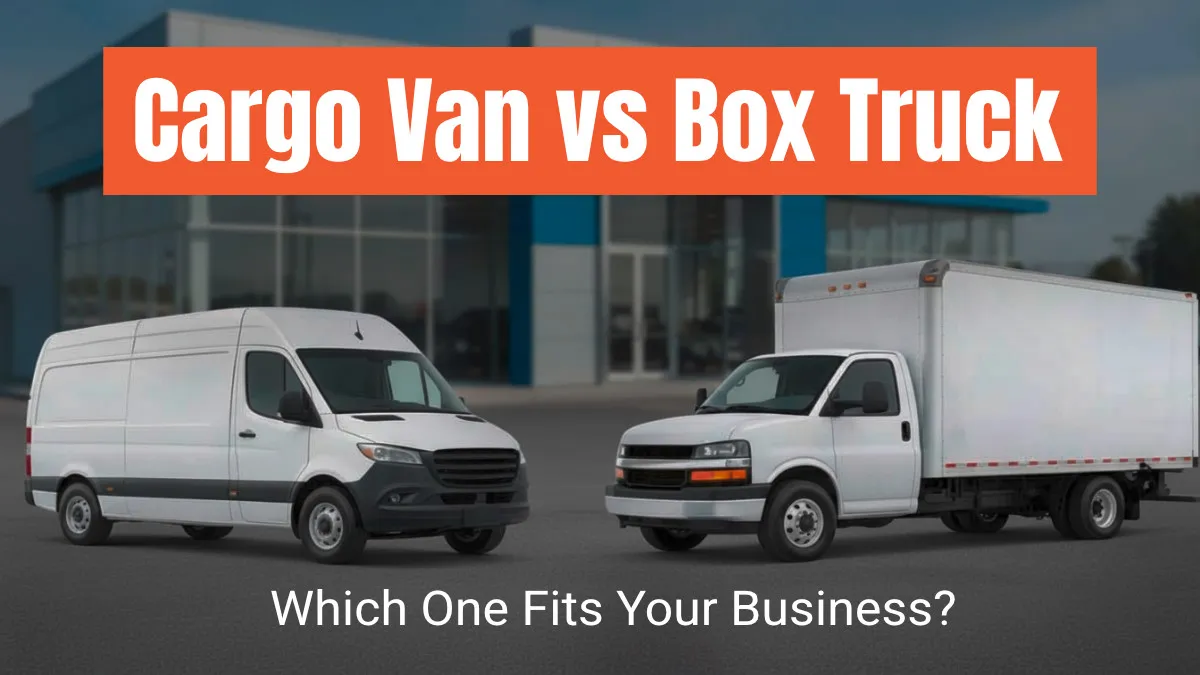
If you're buying a commercial vehicle for delivery, moving, contracting, or any kind of hauling, the first real decision is cargo van or box truck. They overlap just enough to make the choice confusing, but they're fundamentally different vehicles built for different jobs.
A cargo van is nimble, fuel-efficient, and easy to drive. A box truck carries two to four times the volume and significantly more weight. The right choice depends on what you're hauling, where you're driving, and how much you're willing to spend on fuel and maintenance.
This guide breaks down the real differences, with actual numbers, so you can decide which one fits your operation.
What's the Actual Difference?
A cargo van is a single vehicle where the cargo area and cab are one connected unit. You can walk from the driver's seat to the cargo area. Common examples: Ford Transit, Ram ProMaster, Mercedes Sprinter, Chevrolet Express.
A box truck (also called a straight truck or cube truck) is a cab-and-chassis with a separate enclosed cargo box mounted on the back. The cab and cargo area are separated by a wall. Common examples: Isuzu NPR, Ford E-450 with box, Freightliner M2 106, Hino 268.
That structural difference drives everything else: how much you can carry, how easy it is to drive, what it costs to own, and whether you need a commercial driver's license.
Side-by-Side Comparison
| Cargo Van | Box Truck | |
|---|---|---|
| Cargo volume | 250 - 500 cu ft | 700 - 1,700 cu ft |
| Payload capacity | 2,500 - 4,500 lbs | 5,000 - 16,000 lbs |
| Typical GVWR | 8,500 - 10,400 lbs (Class 2b-3) | 12,500 - 33,000 lbs (Class 3-7) |
| CDL required? | No | Only if GVWR exceeds 26,000 lbs |
| Fuel economy | 13 - 20 MPG | 8 - 14 MPG |
| Used price range | $15,000 - $45,000 | $15,000 - $80,000+ |
| Insurance (annual) | $1,800 - $4,000 | $3,000 - $8,000 |
| Ease of driving | Similar to a large SUV | Requires practice, limited visibility |
| Parking | Fits in most parking spots | May need commercial parking |
| Liftgate available? | Rarely | Common, highly recommended |
Cargo Space: How Much Do You Actually Need?
This is the deciding factor for most buyers. Here's what the most common vehicles actually hold:
| Vehicle | Cargo Volume | Max Payload | Cargo Floor Length |
|---|---|---|---|
| Ford Transit (high roof, extended) | 487 cu ft | 4,300 lbs | ~13 ft |
| Ram ProMaster (high roof, 159") | 420 cu ft | 4,400 lbs | ~12.5 ft |
| Mercedes Sprinter (high roof, 170") | 488 cu ft | 3,500 lbs | ~14 ft |
| Chevrolet Express 3500 | 284 cu ft | 3,600 lbs | ~10 ft |
| Isuzu NPR (14' box) | ~840 cu ft | 6,500 lbs | 14 ft |
| Isuzu NPR-HD (16' box) | ~960 cu ft | 7,500 lbs | 16 ft |
| Ford E-450 (16' box) | ~960 cu ft | 6,000 lbs | 16 ft |
| Freightliner M2 106 (24' box) | ~1,500 cu ft | 14,000 lbs | 24 ft |
| Hino 268 (26' box) | ~1,700 cu ft | 15,000 lbs | 26 ft |
A high-roof cargo van maxes out around 490 cubic feet. A 16-foot box truck roughly doubles that. A 26-foot box truck triples it. If you regularly need to move furniture, appliances, palletized freight, or large equipment, a cargo van will run out of space fast.
But if you're delivering packages, tools, small equipment, or supplies, a cargo van gives you plenty of room with far less overhead.
CDL Requirements: The 26,001 lb Line
This is a critical factor that a lot of first-time buyers overlook. The CDL threshold is based on GVWR (Gross Vehicle Weight Rating), not actual weight. If the manufacturer rated the truck at over 26,000 lbs, you need a Class B CDL to drive it, even if you're carrying an empty box.
- Cargo vans: No CDL. Every cargo van on the market is well under 26,001 lbs GVWR.
- Box trucks under 26,001 lbs GVWR: No CDL. This includes most Class 3-5 trucks like the Isuzu NPR, Ford E-450, and Hino 195. These are the most popular box trucks for small businesses specifically because they don't require a CDL.
- Box trucks over 26,001 lbs GVWR: Class B CDL required. This includes larger Class 6-7 trucks like the Freightliner M2 112, International MV, and some configurations of the Hino 268 and Kenworth K270.
If you're hiring drivers, staying under the CDL threshold dramatically expands your hiring pool. CDL holders command higher wages and are harder to find. This is why so many delivery and moving companies run fleets of non-CDL box trucks.
When a Cargo Van is the Right Choice
- Last-mile delivery: Package delivery, courier services, e-commerce fulfillment. Vans are faster to load/unload, easier to park, and more fuel-efficient on routes with frequent stops.
- Trades and contracting: Plumbers, electricians, HVAC techs, and general contractors carry tools and materials, not bulk freight. A van with shelving is purpose-built for this.
- Mobile services: Carpet cleaning, locksmith, pest control, mobile detailing. The van doubles as a workshop.
- Catering and small-scale food delivery: If you're not running a full kitchen, a refrigerated van (reefer van) handles catering runs and wholesale delivery well.
- Urban routes: If your routes run through dense city streets, parking garages, or residential neighborhoods, a box truck becomes a liability. Vans fit where trucks can't.
When a Box Truck is the Right Choice
- Moving companies: Even a small residential move needs more than 500 cubic feet. A 16-foot or 20-foot box truck is the minimum for most moves.
- Freight and distribution: Route-based delivery of beverages, building materials, wholesale goods, or palletized freight. You need the payload capacity and dock-height loading.
- Landscaping: Hauling mowers, soil, mulch, and equipment. Many landscapers run flatbed or box trucks with landscape bodies.
- Large equipment transport: Appliances, vending machines, furniture, and industrial equipment that won't fit through a van's rear doors.
- Food trucks: A box truck chassis is the foundation for most food truck builds. The box provides the kitchen space.
Cost of Ownership: Cargo Van vs Box Truck
The purchase price is only part of the picture. Here's what a year of ownership actually looks like for each:
| Annual Cost | Cargo Van | Box Truck (Class 4-5) |
|---|---|---|
| Fuel (20,000 mi/year) | $4,000 - $6,000 | $6,000 - $10,000 |
| Insurance | $1,800 - $4,000 | $3,000 - $8,000 |
| Maintenance & repairs | $1,500 - $3,000 | $2,500 - $5,000 |
| Tires (per set) | $600 - $1,200 | $1,200 - $3,000 |
| Registration & DOT fees | $200 - $600 | $500 - $1,500 |
| Total annual operating cost | $8,100 - $14,800 | $13,200 - $27,500 |
A box truck costs roughly 50-80% more per year to operate than a cargo van. That's a real number. If a cargo van can handle the job, it will almost always be the more cost-effective choice.
But cost per cubic foot tells a different story. If you need to move 1,000 cubic feet of goods, you'd need two or three cargo van trips to match what one box truck does in a single run. For high-volume operations, the box truck's higher cost per mile is offset by fewer trips, fewer hours, and less labor.
What Used Cargo Vans and Box Trucks Actually Cost
| Vehicle | 5-8 Years Old | 3-5 Years Old | Key Factor |
|---|---|---|---|
| Ford Transit (high roof) | $18,000 - $28,000 | $28,000 - $42,000 | Roof height & wheelbase |
| Ram ProMaster | $15,000 - $25,000 | $25,000 - $38,000 | FWD, low cargo floor |
| Mercedes Sprinter | $20,000 - $35,000 | $35,000 - $50,000 | Diesel, higher maintenance cost |
| Chevrolet Express / GMC Savana | $12,000 - $22,000 | $22,000 - $32,000 | Cheap parts, simple to fix |
| Isuzu NPR (14-16' box) | $18,000 - $30,000 | $30,000 - $45,000 | Box condition, liftgate |
| Ford E-450 (16' box) | $15,000 - $28,000 | $25,000 - $40,000 | Gas engine, no CDL |
| Freightliner M2 106 (24-26' box) | $25,000 - $45,000 | $40,000 - $65,000 | Diesel, may need CDL |
| Hino 268 (26' box) | $28,000 - $48,000 | $42,000 - $68,000 | Strong resale, diesel |
Liftgates add value. A box truck with a working hydraulic liftgate is worth $2,000-$4,000 more than one without. If you're moving anything heavy, a liftgate isn't optional. Retrofitting one costs $3,000-$6,000 installed.
Box condition matters a lot. Rust holes, damaged roll-up doors, cracked fiberglass panels, and leaking roofs are expensive to fix. A box truck with a sound, dry cargo box is worth paying more for. Interior damage from water intrusion can also destroy whatever you're hauling.
What to Inspect Before Buying
Cargo van inspection
- Check for rust on the body panels, wheel wells, and undercarriage
- Inspect the cargo area floor for holes, soft spots, or excessive wear
- Test the sliding door and rear door mechanisms, they get heavy use and wear out
- Look at the partition wall between cab and cargo for damage
- If it's a Sprinter, check for diesel particulate filter (DPF) issues and turbo health, these are the most expensive Sprinter repairs
- Verify the roof height matches what you need, you can't change it later
Box truck inspection
- Inspect the box interior and exterior for rust, dents, and holes. Close the doors, turn off the lights, and look for daylight coming through, any light means water gets in
- Test the roll-up door or swing doors. A roll-up door replacement costs $1,500-$3,000
- Check the box floor for rot, soft spots, and broken crossmembers, especially near the liftgate
- If it has a liftgate, cycle it multiple times with weight on it. Check hydraulic lines for leaks
- Inspect the connection between cab and box for rust and structural integrity
- Check brake drums and air brake system (if equipped) for wear
- Look at the frame rails under the box, frame rust on a box truck can be a deal-breaker
For both vehicles: get a pre-purchase inspection from a commercial vehicle mechanic ($100-$250). Pull a vehicle history report. Check maintenance records. A truck with documented service history is always worth a premium over one without.
Frequently Asked Questions
Do I need a CDL to drive a box truck?
It depends on the GVWR. Any single vehicle with a gross vehicle weight rating over 26,000 lbs requires a Class B CDL. Most box trucks used for local delivery (Isuzu NPR, Ford E-450, Freightliner M2 106) have a GVWR under 26,001 lbs and do not require a CDL. Larger straight trucks like the International MV or Freightliner M2 112 can exceed that threshold.
What is the difference between a cargo van and a box truck?
A cargo van is a unibody or body-on-frame vehicle where the cargo area is integrated with the cab. Common examples include the Ford Transit, Ram ProMaster, and Mercedes Sprinter. A box truck has a separate enclosed cargo box mounted on a cab-and-chassis. Box trucks offer significantly more cargo volume (typically 700-1,700 cubic feet vs 250-500 for vans) but are larger and harder to maneuver in urban areas.
Is a cargo van or box truck better for a delivery business?
For last-mile delivery with frequent stops in residential areas, a cargo van is usually better due to easier parking, better fuel economy, and lower operating costs. For larger deliveries, route-based distribution, or moving heavy items, a box truck provides the cargo space and payload capacity you need. Many delivery businesses start with a van and add box trucks as volume grows.
How much does a used cargo van cost compared to a used box truck?
Used cargo vans typically cost $15,000-$45,000 depending on year, mileage, and condition. Used box trucks range from $15,000-$60,000 for Class 3-5 trucks (like the Isuzu NPR or Ford E-450) and $30,000-$80,000+ for Class 6-7 trucks (like the Freightliner M2). Price varies significantly based on mileage, box condition, and whether the truck has a liftgate.
What is the best cargo van for commercial use?
The most popular commercial cargo vans are the Ford Transit, Ram ProMaster, and Mercedes Sprinter. The Transit offers the widest range of configurations. The ProMaster has the lowest cargo floor height, which makes loading easier. The Sprinter is known for durability and diesel efficiency but costs more upfront and to maintain. The Chevrolet Express and GMC Savana are older designs but are mechanically simple and inexpensive to repair.
Find your next commercial vehicle
Browse used cargo vans and box trucks for sale on Haulver. Filter by price, category, and location to find the right one for your business.